Bodies
Contours
The early AVRI bodies produced at the Fullerton, CA plant (1982-1984) had many characteristic features from the later bodies produced at the Corona, CA plant (1985-present). Namely, the rear cutout on Fullerton era strats were deeper, longer, and had a more subtle transition into the rest of the body. This created a top edge of the body that was sleek and thin compared to the more squared top edge of later reissues. These sleek "Fullerton contours" were also found on the very first reissues to come out of the Corona plant. It is thought that the very first Corona factory reissues actually used bodies that were left over from the Fullerton factory and thus constructed on the old dies and machines as the earlier Fullerton reissues. From my experience, serial numbers in the low V020000's typically have these "Fullerton contours." It was not until serial numbers in the mid to high V020000's (early/mid 1987) that the contours changed on Corona factory produced guitars. These later reissues had an asymmetric rear cutout that had a sharper transition into the rest of the body. Along with this, the top edge of the body was left more square.
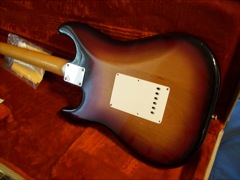
Back contour of a 1982 reissue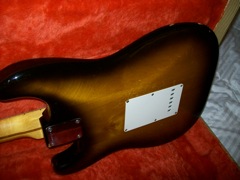
Back contour of a 1982 reissue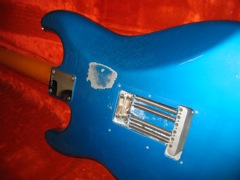
Back contour of a 1983 reissue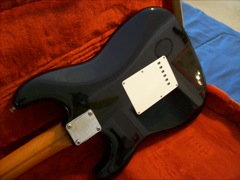
Back contour of a 1987 reissue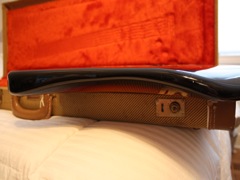
Thin top edge of a 1982 reissue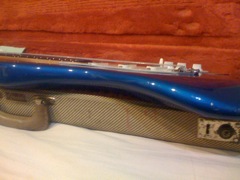
Thin top edge of a 1987 reissue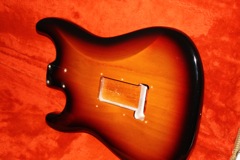
Back contour of a 1989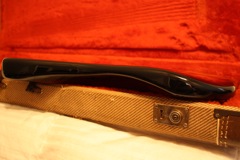
Top edge of a 1989 reissue
Routing
During initial assembly of the very first 1982 AVRI stratocasters, Fender had many problems with completed pickup assemblies fitting in the pickup and control cutouts. Many of these very early 1982 AVRI strats had to have a small section of wood removed in order to accomodate the pickup assemblies. This was done on the assembly line using a small handheld pin-router after finishes had been applied. The result was a very thin section of wood being routed from the backside of the bridge pickup cutout as well as edges of the control cavity cutout. On the very first bodies it is common to have more routing done, as it took several weeks to nail down what specific areas of the cavities were actually causing the problem. Tooling changes at the end of 1982 corrected this problem, relieving the need for assembly line pin-routing.

V000939 factory pin routing
V000939 factory pin routing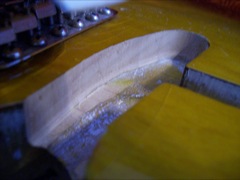
V000978 factory pin routing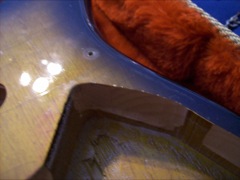
V000978 factory pin routing
Serial Numbers
A few of the early 1982 reissues had a small rectangular sticker stamped with the serial number in the neck pocket. This is a rare feature and is only found on early 1982 AVRI strats.
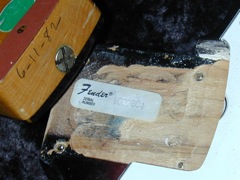
V000204 neck pocket sticker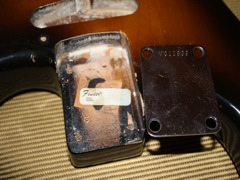
V000939 neck pocket sticker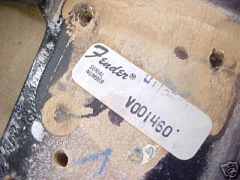
V001460 neck pocket sticker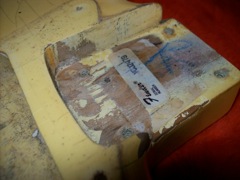
V002479 neck pocket sticker
Dates
Early AVRI Stratocasters made at the Fullerton factory do not have date stamps in the neck pocket. Only a few 1982 AVRI strats left the factory with a small black ink date stamp in the tremolo cutout on the rear of the body. It was not until 1987 that date stamps were regularly used in the neck pocket. This was done inconsistently during the late 1980's and it was not until the 1990's that date stamps were consistently used in the neck pocket.
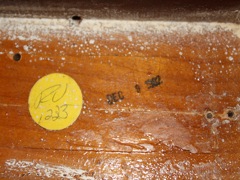
1982 tremolo cavity date stamp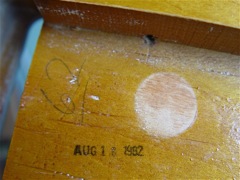
1982 tremolo cavity date stamp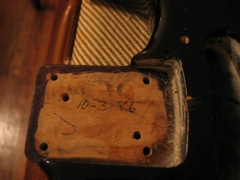
1986 neck pocket date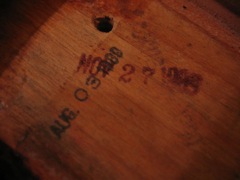
1989 neck pocktet date stamp
Worm Route
All AVRI stratocasters have a "worm-hole route" in the bridge position. There was inconsistency through the years with the shape of the worm-hole route. This route can either be a straight line with a small triangle shape or an L shape.
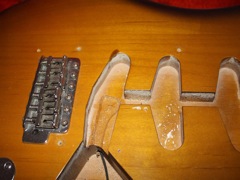
Worm route shape #1
Worm route shape #2
©2009 The Fender Reissue Shop. All Rights Reserved.
Site By
